How to Read a Plate's Spec Sheet: Rating, Threat List, Weight, Thickness, Cut

How to Read a Plate's Spec Sheet: Rating, Threat List, Weight, Thickness, Cut

0 comments

How to Read a Plate's Spec Sheet: Rating, Threat List, Weight, Thickness, Cut

A plate's spec sheet is a short document that answers a long question: what is this thing, and is it the right thing for me? Read top to bottom, five fields carry almost all the meaning — the rating, the threat list, the weight, the thickness, and the cut/size. The rating tells you which standard the plate was tested against. The threat list tells you which specific rounds that testing covered — and that list is the field most buyers skip, even though it's the one that answers "will this do what I need." Everything else on the sheet tells you what you'll actually feel wearing it for eight hours.

Here's how to read each line, in order, and what none of them can tell you.

In this article

What is a plate spec sheet, actually?

A spec sheet is a summary of test results and physical measurements. It is not a promise about your specific situation. Two plates with the same headline rating can differ in weight by pounds, in thickness by a quarter inch, in cut, in curve, and in the exact list of rounds each was tested against.

Read it in this order: rating → threat list → weight → thickness → cut. That sequence moves from "is this the right class of armor" to "will I actually wear it."

What does the rating line tell you?

The rating is the standard a plate was tested to. In the U.S. that framework comes from the National Institute of Justice (NIJ). You will see two generations of language in the market right now:

  • Older 0101.06 language: Level III, Level IV.
  • Newer 0101.07 language: RF1, RF2, RF3.

They are different standards with different test protocols, so a plate described under one is not automatically equivalent to the other. When a plate lists both — as our Dominus AR700 does with RF1/RF2 — read the product's own description for what it carries and against what.

You will also see "+" designations like Level III+. This is important: "III+" is not an NIJ level. There is no NIJ certification called III+. It is manufacturer shorthand meaning "Level III construction that was additionally tested against something above the standard III threat set." Whether that means anything depends entirely on the next field down — the threat list. Treat any "+" as a prompt to go read what was actually tested, not as a rating in itself.

Warden AR600 Lightweight Level III+ Steel Rifle Plate
Steel workhorse
Warden AR600 Lightweight Level III+ Steel Rifle Plate

Our entry-point steel rifle plate, listed as Level III+ — read its threat list on the product page to see exactly what that designation covers.

From $89.99 View product →

What does the rating NOT cover?

This is the part of the sheet that isn't written down. A rating does not tell you:

  • Rounds outside the tested list. A level is tested against defined threats at defined velocities. Anything not on that list was not part of that test.
  • Velocity beyond the test. Barrel length, distance, and load all change impact velocity. Test velocities are fixed numbers; the real world is not.
  • Angle and edge hits. Testing uses defined shot placement and spacing. A round at an odd angle or near the plate edge is a different event.
  • Age, drops, and storage. Ceramic in particular is a material that can be damaged by impact you can't see. A rating is a snapshot of a new plate under lab conditions.
  • Anything outside the plate's footprint. Armor covers what it covers.
  • Blunt trauma. Stopping penetration and preventing injury are two different measurements — see backface below.

None of this makes ratings less useful. It makes them a floor to reason from rather than a guarantee to rely on.
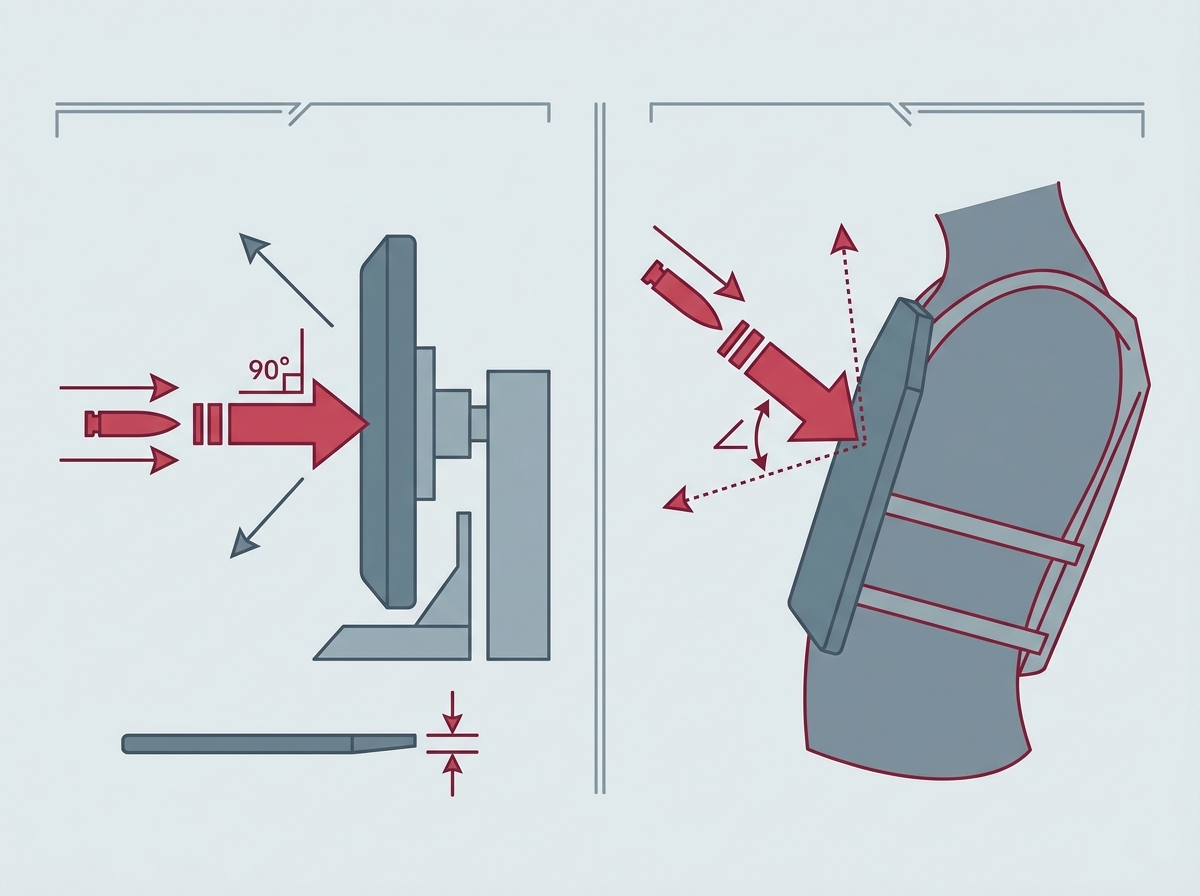
Diagram comparing controlled lab test conditions to real-world wear angles
A rating describes performance under a defined test protocol — not every condition you'll meet.

Why does the threat list matter more than the level?

Because the level is a category and the threat list is the actual data. A threat list names the specific projectiles a plate was tested against — caliber, bullet construction, and the velocity used.

This matters most when two plates share a headline. Two plates both described as "III+" can have meaningfully different threat lists, because the "+" is defined by the manufacturer, not the standard. The only way to compare them is to put the lists next to each other.

Practical rule: decide what you need to defeat first, then find a plate whose tested threat list covers it. Do not start with a level and assume coverage flows downhill.

Aegis Special Rifle Threat RF2 Body Armor Hybrid Rifle Plate
Hybrid construction
Aegis Special Rifle Threat RF2 Body Armor Hybrid Rifle Plate

A hybrid-construction plate carried under the newer RF2 designation — check its listed threat set against the specific rounds that concern you.

From $214.99 View product →

How should I read weight?

Weight is the field that decides whether your armor gets worn or gets left in the truck.

Read it carefully, because sheets differ in what they're quoting:

  • Per plate or per pair? A "6.5 lb" number reads very differently if it's the set.
  • Which size? Weight scales with cut and size. A 10x12 weighs more than an 8x10 of the same construction.
  • Plate only, or with coating/cover? Steel plates are usually quoted with their anti-spall coating; that coating has real mass.
  • Does it include the carrier? It usually doesn't. Add your carrier, side plates, trauma pads, and everything on your belt to get the number your shoulders actually carry.

As a broad material trend: steel tends to be the heaviest and least expensive, polyethylene the lightest and typically the most expensive per unit of protection, and ceramic and hybrid constructions land in between with their own trade-offs. That's a trend, not a rule — check the sheet.

Agilis Ultralight Level III+ Polyethylene Rifle Plate Lightweight Body Armor
Weight-first option
Agilis Ultralight Level III+ Polyethylene Rifle Plate Lightweight Body Armor

Polyethylene construction for buyers whose limiting factor is how long they can actually wear the kit.

From $199.99 View product →

What does thickness really tell me?

Thickness tells you profile — how far the plate stands off your chest, how it prints under a jacket, how it interacts with a rifle stock when you shoulder it, and how it affects your reach across the front of your body.

Thin does not mean better and thick does not mean stronger. Polyethylene plates are frequently thicker than steel plates while weighing considerably less, because the materials achieve their result differently. Read thickness as an ergonomics number, not a protection number.

One more note: thickness is usually quoted at the plate's thickest point. Multi-curve plates vary across their surface.

What do cut, size, and curve mean?

Three separate fields that people collapse into one.

  • Size is the nominal dimension — 10x12, 8x10, 6x6 for sides. Bigger covers more and weighs more.
  • Cut is the shape of the shoulder area. SAPI/Shooter's Cut angles the upper corners for arm clearance. Swimmer's Cut removes more material for a wider range of motion, at the cost of coverage. Full/Rectangle keeps everything.
  • Curve describes how the plate is shaped to the torso — single-curve bends in one direction, multi-curve in more than one for closer fit. Multi-curve generally rides better; single-curve is simpler and often cheaper.

Two fit checks people skip: your plate must fit your carrier's pocket, and your plate size should be driven by your torso, not by "bigger is better." A plate that rides too high or too low doesn't protect what it's sized to protect.

Invictus Pattern MK I Modular Plate Carrier
Platform first
Invictus Pattern MK I Modular Plate Carrier

Confirm your chosen plate's size and cut against the carrier pocket before you order either one.

From $149.99 View product →

What about backface, trauma, and multi-hit?

Three fields that separate "the round didn't get through" from "and I was fine afterward."

  • Backface deformation (BFD) is how far the back of the plate deforms into the clay backing during testing. It's a proxy for blunt trauma transmitted to the body. The standard sets a maximum allowable figure — lower measured numbers mean less energy handed to you.
  • Multi-hit means the plate was tested for more than one impact under the standard's shot-spacing rules. Those rules define spacing; rounds landing closer together are outside what was tested.
  • Trauma pads sit behind the plate and add a layer that helps manage blunt impact and comfort. They're not part of the ballistic rating and don't change it — they're a separate, additive item.
EVA Composite Armor Trauma Pads | Kinetic Impact Backers (Set of 2)
Behind the plate
EVA Composite Armor Trauma Pads | Kinetic Impact Backers (Set of 2)

A separate backer layer for blunt-impact management and day-long comfort — it does not alter a plate's rating.

From $24.99 View product →

Also worth checking on the sheet: spall and fragmentation handling (especially relevant for steel, where a coating manages fragmentation), environmental conditioning (was the plate tested after temperature/humidity exposure?), and shelf life or warranty period, which differ by material — polyethylene and ceramic have their own storage and handling considerations that steel doesn't.

How do I compare two spec sheets side by side?

Build the table yourself. Copy each sheet into the same rows and the gaps become obvious.

Spec sheet field What it tells you What it does not tell you
Rating (III/IV or RF1/RF2/RF3) Which standard and test protocol the plate was evaluated under That "+" designations are certified levels — they are manufacturer language
Threat list The specific rounds and velocities tested Performance against anything not on the list
Weight Load you'll carry; whether it's per plate or per pair Carrier, sides, pads, or the rest of your kit
Thickness Profile, standoff, printing, rifle-stock clearance Protection level — thicker isn't stronger
Size & cut Coverage area and shoulder/arm mobility Whether it fits your torso or your carrier pocket
Curve How closely it conforms to the chest Comfort under load with your specific carrier
Backface deformation Deformation measured under the standard's test Injury outcome for any individual
Multi-hit Tested for multiple impacts at defined spacing Hits closer than the tested spacing, or on edges
Construction (steel / PE / ceramic / hybrid) Weight, thickness, and handling trade-offs Which one is "best" — that depends on your threat list

Work the table in this order: threat list first (does it cover what I need?), weight second (will I wear it?), then size, cut, and curve (does it fit me and my carrier?). Rating narrows the field. The other rows pick the plate.

Sanctum Level IV Armor | RF3 Armor Silicon Carbide Ceramic Rifle Plate
Ceramic option
Sanctum Level IV Armor | RF3 Armor Silicon Carbide Ceramic Rifle Plate

Silicon carbide ceramic construction listed at Level IV / RF3 — read its threat list and handling notes before choosing on the headline alone.

From $279.99 View product →

Frequently asked questions

Is "Level III+" an official NIJ rating?

No. NIJ publishes Level III and Level IV under 0101.06, and RF1, RF2, and RF3 under 0101.07. "III+" is manufacturer shorthand for Level III construction tested against additional threats beyond the standard III set. It's meaningful only in combination with the threat list that defines it, so read that list.

Does a higher rating always mean better protection for me?

Not automatically. A higher rating generally means a broader or more demanding tested threat set, but it usually also means more weight, more thickness, or a higher price. The right plate is the lightest one whose tested threat list covers the threats you've actually identified.

Why do two plates with the same rating weigh so differently?

Material and construction. Steel, polyethylene, ceramic, and hybrid builds reach their tested result by different means, with different weight and thickness penalties. That's why weight and thickness are separate fields from the rating.

What's the difference between Shooter's Cut and Swimmer's Cut?

Both angle the upper corners for arm clearance. Swimmer's Cut removes more material than Shooter's/SAPI Cut, giving greater range of motion with less coverage in the upper chest and shoulder area. Which you want depends on how much you need to move versus how much you need covered.

Do trauma pads change a plate's rating?

No. Trauma pads are a separate item worn behind the plate to help manage blunt impact and improve comfort. They are not part of the ballistic testing and do not change what the plate is rated to.

How do I know what size plate I need?

Measure your torso, not your shirt size. The plate should cover your vital area without riding into your throat or blocking your hips when you sit or shoulder a rifle. Then confirm that size and cut fit the pocket of the carrier you plan to use.

Should I buy on rating or on weight?

Neither alone. Start with the threat list, use the rating to confirm which standard produced it, then let weight, thickness, and cut decide between the remaining candidates. Armor you don't wear protects nothing.

Compare the spec sheets yourself

Every rifle plate we sell lists its rating, tested threat set, construction, and dimensions on the product page — read them side by side before you choose.

Browse rifle plates →

Tags:
Steel vs. Ceramic vs. Polyethylene Body Armor: How to Choose the Right Rifle Plate

Do You Need a Ballistic Helmet? The Vigil IIIA Guide to Head Protection

Leave a comment

How to Read a Plate's Spec Sheet: Rating, Threat List, Weight, Thickness, Cut

0 comments

How to Read a Plate's Spec Sheet: Rating, Threat List, Weight, Thickness, Cut

How to Read a Plate's Spec Sheet: Rating, Threat List, Weight, Thickness, Cut

A plate's spec sheet is a short document that answers a long question: what is this thing, and is it the right thing for me? Read top to bottom, five fields carry almost all the meaning — the rating, the threat list, the weight, the thickness, and the cut/size. The rating tells you which standard the plate was tested against. The threat list tells you which specific rounds that testing covered — and that list is the field most buyers skip, even though it's the one that answers "will this do what I need." Everything else on the sheet tells you what you'll actually feel wearing it for eight hours.

Here's how to read each line, in order, and what none of them can tell you.

In this article

What is a plate spec sheet, actually?

A spec sheet is a summary of test results and physical measurements. It is not a promise about your specific situation. Two plates with the same headline rating can differ in weight by pounds, in thickness by a quarter inch, in cut, in curve, and in the exact list of rounds each was tested against.

Read it in this order: rating → threat list → weight → thickness → cut. That sequence moves from "is this the right class of armor" to "will I actually wear it."

What does the rating line tell you?

The rating is the standard a plate was tested to. In the U.S. that framework comes from the National Institute of Justice (NIJ). You will see two generations of language in the market right now:

  • Older 0101.06 language: Level III, Level IV.
  • Newer 0101.07 language: RF1, RF2, RF3.

They are different standards with different test protocols, so a plate described under one is not automatically equivalent to the other. When a plate lists both — as our Dominus AR700 does with RF1/RF2 — read the product's own description for what it carries and against what.

You will also see "+" designations like Level III+. This is important: "III+" is not an NIJ level. There is no NIJ certification called III+. It is manufacturer shorthand meaning "Level III construction that was additionally tested against something above the standard III threat set." Whether that means anything depends entirely on the next field down — the threat list. Treat any "+" as a prompt to go read what was actually tested, not as a rating in itself.

Warden AR600 Lightweight Level III+ Steel Rifle Plate
Steel workhorse
Warden AR600 Lightweight Level III+ Steel Rifle Plate

Our entry-point steel rifle plate, listed as Level III+ — read its threat list on the product page to see exactly what that designation covers.

From $89.99 View product →

What does the rating NOT cover?

This is the part of the sheet that isn't written down. A rating does not tell you:

  • Rounds outside the tested list. A level is tested against defined threats at defined velocities. Anything not on that list was not part of that test.
  • Velocity beyond the test. Barrel length, distance, and load all change impact velocity. Test velocities are fixed numbers; the real world is not.
  • Angle and edge hits. Testing uses defined shot placement and spacing. A round at an odd angle or near the plate edge is a different event.
  • Age, drops, and storage. Ceramic in particular is a material that can be damaged by impact you can't see. A rating is a snapshot of a new plate under lab conditions.
  • Anything outside the plate's footprint. Armor covers what it covers.
  • Blunt trauma. Stopping penetration and preventing injury are two different measurements — see backface below.

None of this makes ratings less useful. It makes them a floor to reason from rather than a guarantee to rely on.

Diagram comparing controlled lab test conditions to real-world wear angles
A rating describes performance under a defined test protocol — not every condition you'll meet.

Why does the threat list matter more than the level?

Because the level is a category and the threat list is the actual data. A threat list names the specific projectiles a plate was tested against — caliber, bullet construction, and the velocity used.

This matters most when two plates share a headline. Two plates both described as "III+" can have meaningfully different threat lists, because the "+" is defined by the manufacturer, not the standard. The only way to compare them is to put the lists next to each other.

Practical rule: decide what you need to defeat first, then find a plate whose tested threat list covers it. Do not start with a level and assume coverage flows downhill.

Aegis Special Rifle Threat RF2 Body Armor Hybrid Rifle Plate
Hybrid construction
Aegis Special Rifle Threat RF2 Body Armor Hybrid Rifle Plate

A hybrid-construction plate carried under the newer RF2 designation — check its listed threat set against the specific rounds that concern you.

From $214.99 View product →

How should I read weight?

Weight is the field that decides whether your armor gets worn or gets left in the truck.

Read it carefully, because sheets differ in what they're quoting:

  • Per plate or per pair? A "6.5 lb" number reads very differently if it's the set.
  • Which size? Weight scales with cut and size. A 10x12 weighs more than an 8x10 of the same construction.
  • Plate only, or with coating/cover? Steel plates are usually quoted with their anti-spall coating; that coating has real mass.
  • Does it include the carrier? It usually doesn't. Add your carrier, side plates, trauma pads, and everything on your belt to get the number your shoulders actually carry.

As a broad material trend: steel tends to be the heaviest and least expensive, polyethylene the lightest and typically the most expensive per unit of protection, and ceramic and hybrid constructions land in between with their own trade-offs. That's a trend, not a rule — check the sheet.

Agilis Ultralight Level III+ Polyethylene Rifle Plate Lightweight Body Armor
Weight-first option
Agilis Ultralight Level III+ Polyethylene Rifle Plate Lightweight Body Armor

Polyethylene construction for buyers whose limiting factor is how long they can actually wear the kit.

From $199.99 View product →

What does thickness really tell me?

Thickness tells you profile — how far the plate stands off your chest, how it prints under a jacket, how it interacts with a rifle stock when you shoulder it, and how it affects your reach across the front of your body.

Thin does not mean better and thick does not mean stronger. Polyethylene plates are frequently thicker than steel plates while weighing considerably less, because the materials achieve their result differently. Read thickness as an ergonomics number, not a protection number.

One more note: thickness is usually quoted at the plate's thickest point. Multi-curve plates vary across their surface.

What do cut, size, and curve mean?

Three separate fields that people collapse into one.

  • Size is the nominal dimension — 10x12, 8x10, 6x6 for sides. Bigger covers more and weighs more.
  • Cut is the shape of the shoulder area. SAPI/Shooter's Cut angles the upper corners for arm clearance. Swimmer's Cut removes more material for a wider range of motion, at the cost of coverage. Full/Rectangle keeps everything.
  • Curve describes how the plate is shaped to the torso — single-curve bends in one direction, multi-curve in more than one for closer fit. Multi-curve generally rides better; single-curve is simpler and often cheaper.

Two fit checks people skip: your plate must fit your carrier's pocket, and your plate size should be driven by your torso, not by "bigger is better." A plate that rides too high or too low doesn't protect what it's sized to protect.

Invictus Pattern MK I Modular Plate Carrier
Platform first
Invictus Pattern MK I Modular Plate Carrier

Confirm your chosen plate's size and cut against the carrier pocket before you order either one.

From $149.99 View product →

What about backface, trauma, and multi-hit?

Three fields that separate "the round didn't get through" from "and I was fine afterward."

  • Backface deformation (BFD) is how far the back of the plate deforms into the clay backing during testing. It's a proxy for blunt trauma transmitted to the body. The standard sets a maximum allowable figure — lower measured numbers mean less energy handed to you.
  • Multi-hit means the plate was tested for more than one impact under the standard's shot-spacing rules. Those rules define spacing; rounds landing closer together are outside what was tested.
  • Trauma pads sit behind the plate and add a layer that helps manage blunt impact and comfort. They're not part of the ballistic rating and don't change it — they're a separate, additive item.
EVA Composite Armor Trauma Pads | Kinetic Impact Backers (Set of 2)
Behind the plate
EVA Composite Armor Trauma Pads | Kinetic Impact Backers (Set of 2)

A separate backer layer for blunt-impact management and day-long comfort — it does not alter a plate's rating.

From $24.99 View product →

Also worth checking on the sheet: spall and fragmentation handling (especially relevant for steel, where a coating manages fragmentation), environmental conditioning (was the plate tested after temperature/humidity exposure?), and shelf life or warranty period, which differ by material — polyethylene and ceramic have their own storage and handling considerations that steel doesn't.

How do I compare two spec sheets side by side?

Build the table yourself. Copy each sheet into the same rows and the gaps become obvious.

Spec sheet field What it tells you What it does not tell you
Rating (III/IV or RF1/RF2/RF3) Which standard and test protocol the plate was evaluated under That "+" designations are certified levels — they are manufacturer language
Threat list The specific rounds and velocities tested Performance against anything not on the list
Weight Load you'll carry; whether it's per plate or per pair Carrier, sides, pads, or the rest of your kit
Thickness Profile, standoff, printing, rifle-stock clearance Protection level — thicker isn't stronger
Size & cut Coverage area and shoulder/arm mobility Whether it fits your torso or your carrier pocket
Curve How closely it conforms to the chest Comfort under load with your specific carrier
Backface deformation Deformation measured under the standard's test Injury outcome for any individual
Multi-hit Tested for multiple impacts at defined spacing Hits closer than the tested spacing, or on edges
Construction (steel / PE / ceramic / hybrid) Weight, thickness, and handling trade-offs Which one is "best" — that depends on your threat list

Work the table in this order: threat list first (does it cover what I need?), weight second (will I wear it?), then size, cut, and curve (does it fit me and my carrier?). Rating narrows the field. The other rows pick the plate.

Sanctum Level IV Armor | RF3 Armor Silicon Carbide Ceramic Rifle Plate
Ceramic option
Sanctum Level IV Armor | RF3 Armor Silicon Carbide Ceramic Rifle Plate

Silicon carbide ceramic construction listed at Level IV / RF3 — read its threat list and handling notes before choosing on the headline alone.

From $279.99 View product →

Frequently asked questions

Is "Level III+" an official NIJ rating?

No. NIJ publishes Level III and Level IV under 0101.06, and RF1, RF2, and RF3 under 0101.07. "III+" is manufacturer shorthand for Level III construction tested against additional threats beyond the standard III set. It's meaningful only in combination with the threat list that defines it, so read that list.

Does a higher rating always mean better protection for me?

Not automatically. A higher rating generally means a broader or more demanding tested threat set, but it usually also means more weight, more thickness, or a higher price. The right plate is the lightest one whose tested threat list covers the threats you've actually identified.

Why do two plates with the same rating weigh so differently?

Material and construction. Steel, polyethylene, ceramic, and hybrid builds reach their tested result by different means, with different weight and thickness penalties. That's why weight and thickness are separate fields from the rating.

What's the difference between Shooter's Cut and Swimmer's Cut?

Both angle the upper corners for arm clearance. Swimmer's Cut removes more material than Shooter's/SAPI Cut, giving greater range of motion with less coverage in the upper chest and shoulder area. Which you want depends on how much you need to move versus how much you need covered.

Do trauma pads change a plate's rating?

No. Trauma pads are a separate item worn behind the plate to help manage blunt impact and improve comfort. They are not part of the ballistic testing and do not change what the plate is rated to.

How do I know what size plate I need?

Measure your torso, not your shirt size. The plate should cover your vital area without riding into your throat or blocking your hips when you sit or shoulder a rifle. Then confirm that size and cut fit the pocket of the carrier you plan to use.

Should I buy on rating or on weight?

Neither alone. Start with the threat list, use the rating to confirm which standard produced it, then let weight, thickness, and cut decide between the remaining candidates. Armor you don't wear protects nothing.

Compare the spec sheets yourself

Every rifle plate we sell lists its rating, tested threat set, construction, and dimensions on the product page — read them side by side before you choose.

Browse rifle plates →
Comments 

No comments

Leave a comment
Your Email Address Will Not Be Published. Required Fields Are Marked *